Hardware
The integrated electronics in a Minitel terminal has four functionally distinct parts:
- The subset visualization responsible for producing the TV images from the signals received by the Minitel or hit on his keyboard.
- The subset keymap loaded recognize the keyboard and hit send their code to the subset visualization and to the telephone line keys.
- The subset serial interface responsible for providing signals to the DIN socket (computer peripherals) to devices.
- The MODEM (modulator-demodulator) that transforms internal digital signals Minitel
These various subsets are grouped on three printed circuit boards.
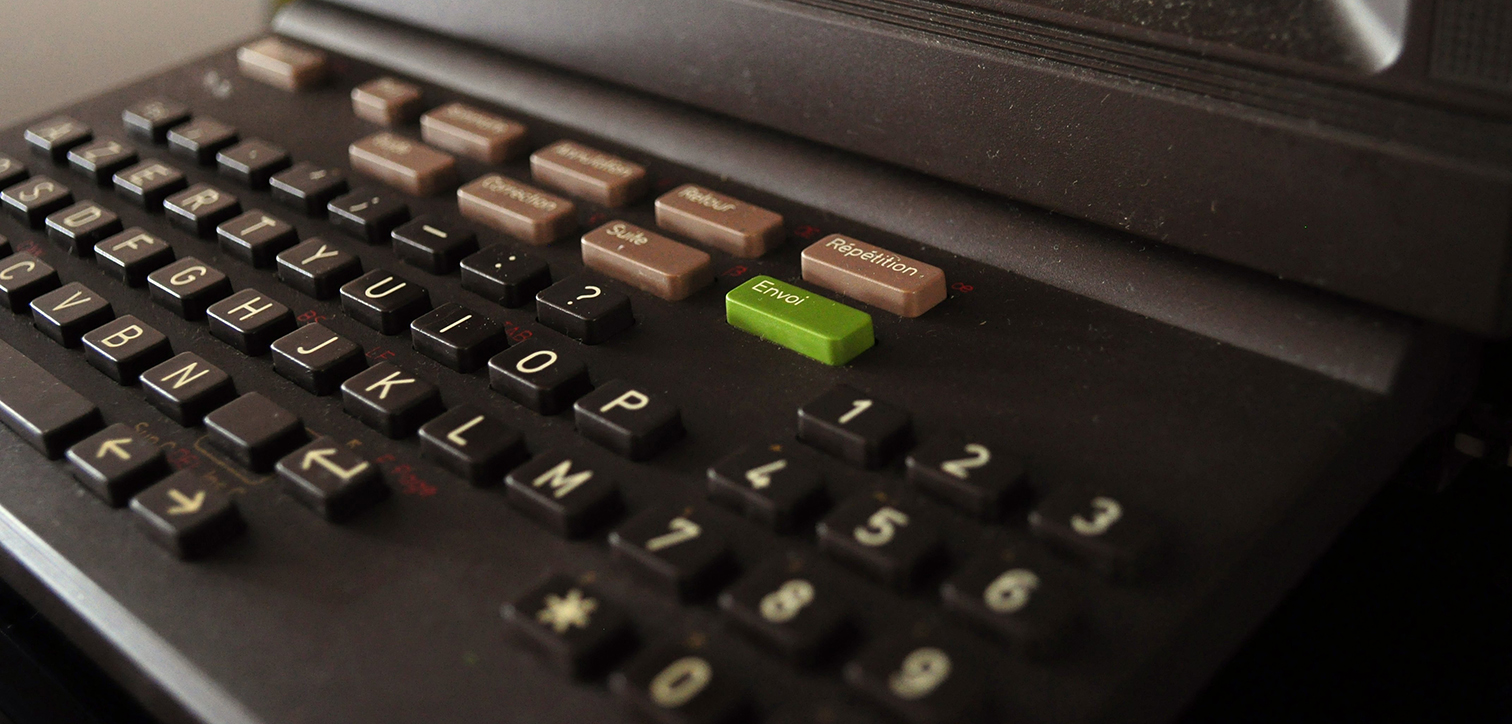
The keyboard of the Minitel is managed by an 8048 microprocessor at Intel. It is a circuit that performs several functions in one housing.
- The heart of the microcontroller: the central processing unit or CPU of 8 bits.
- 64 bytes of RAM.
- 1 KB of ROM.
- An 8-bit timer counter.
- 27 lines of inputs / outputs.
Software integrated in the ROM 8048 provides scanning of 65 keys.
The keystroke causes the production of a code or a code sequence corresponding to the character or indicated on this function. If two keys (or more) simultaneously depresses no action occurs. One of these keys will be taken into account as soon as the others released.
The 8048, two inlets / outlets will provide the determination of the key, is also responsible for the serialization code since there is no standard UART function integrated in the microcontroller and the series is produced by the integrated software. The connection of the keyboard unit is via a six-pin connector carrying the power, mass, and the RESET signal issued by the serial data 8048.
Minitel and the Internet
The extent to which Minitel enhanced or hindered the development of the Internet in France is widely debated. On the one hand, it included more than a thousand services, some of which predicted common applications on the modern Internet. For example, in 1986, French university students coordinated a national strike using Minitel, demonstrating an early use of digital communication devices for participatory technopolitical ends.[15] Alternatively, the French government's attachment to the natively developed Minitel may have slowed the adoption of the Internet in France; in the 1990s there was a peak of nine million terminals and there were still 810,000 terminals in the country in 2012. In the short term, some resources at France Telecom (now Orange) were dedicated to the development of Minitel that might have otherwise been focused on Internet development. However, France Telecom's focus on Minitel had little or no long-term effect on adoption or development of internet- and web-based companies in France; France ranks roughly equal to the US and Germany in the current penetration of high-speed internet in households.